


Euro-Dog Collars and Leads
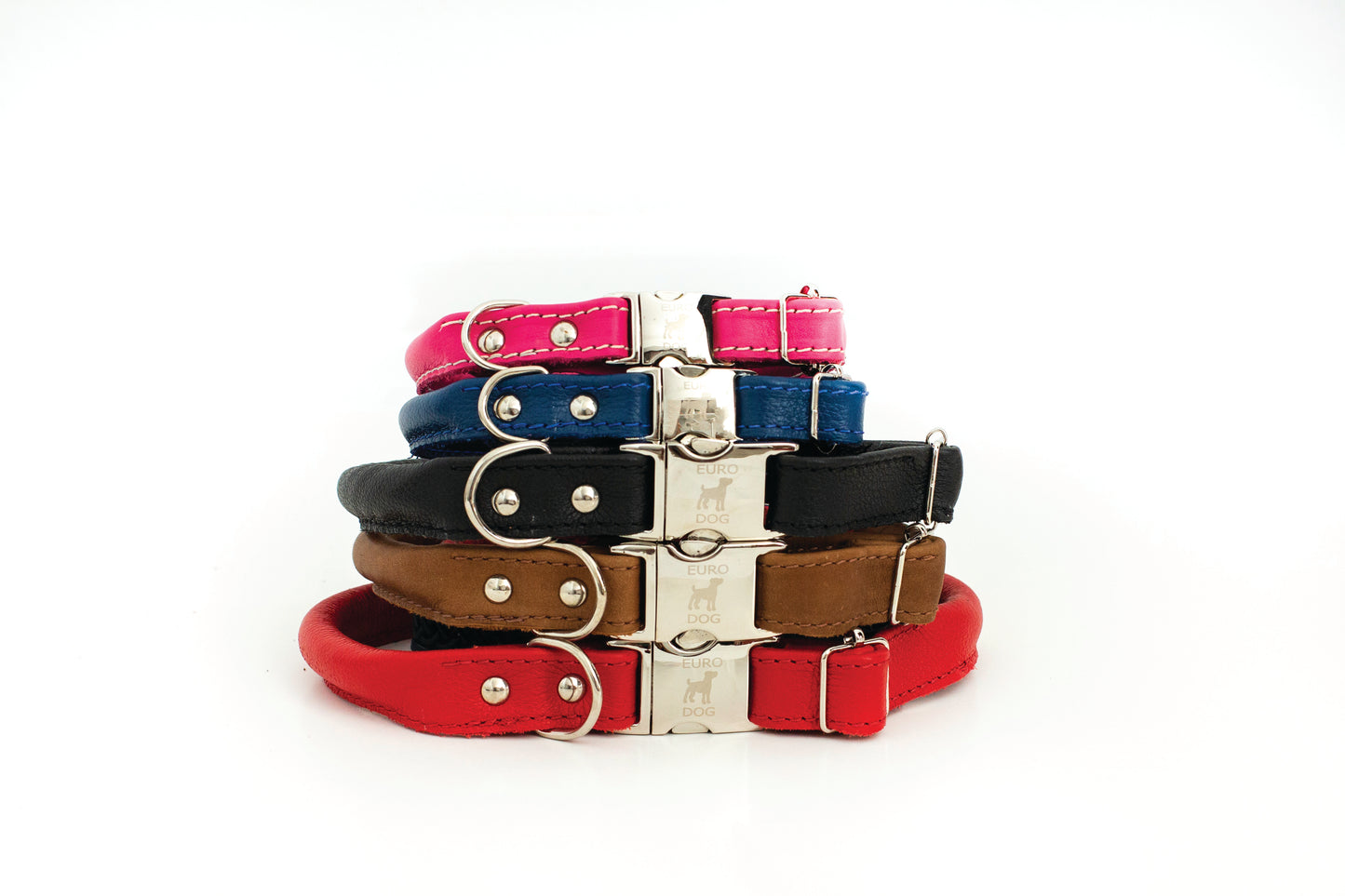
Rolled Leather Quick-Release Dog Collar
Rolled Leather Quick-Release Dog Collar
Couldn't load pickup availability
Soft, supple leather that won't flatten or crack — with the quick-release buckle you actually want to use.
Why we built it this way
Rolled leather sits softer on a dog's neck than flat leather — no edges, no pressure points, no rubbing under the chin. We use full-grain American leather, hand-rolled and saddle-stitched in Denver, so the collar conforms to your dog's neck over weeks instead of breaking down over months.
The quick-release buckle is a YKK polyacetal side-release with a steel D-ring — the same hardware trainers and working-dog handlers trust. One-handed on. One-handed off. No struggling with a belt buckle when your dog is wet, cold, or just done with the walk.
What's in it
Full-grain American leather, vegetable-tanned and rolled by hand
YKK polyacetal quick-release buckle — corrosion-proof, won't freeze in winter, won't rust in surf
Marine-grade steel D-ring, welded closed
Saddle-stitched ends with waxed thread — won't unravel like glue-and-rivet construction
Made in Denver, Colorado by the same small team since 1995
How it ages
Full-grain leather darkens and softens with wear. After a few months of walking, swimming, hiking — your dog's collar starts to look like it belongs to your dog. That's the point. Cheap leather goes the other way: stiff, then cracked, then trash. Ours doesn't.
Sizing
Wrap a soft tape measure around your dog's neck where the collar would sit — snug, with room for two fingers underneath. That number is the size you want. Between sizes? Go up. Leather softens and shapes to your dog's neck over the first 30 days.
XS: 5/8" width, 13"–14" neck
S: 5/8" width, 15"–16" neck
M: 5/8" width, 17"–18" neck
L: 3/4" width, 18"–20" neck
XL: 3/4" width, 20"–22" neck
Care
Wipe with a damp cloth after wet walks. Condition with leather balm every 3–6 months. Don't soak it; don't run it through the washer.
Backed by our 1-year guarantee — if it fails under normal use within a year, we make it right. No fine print.
Sizing Guide
Sizing Guide
How to Measure Your Dog (Properly)
The single biggest reason a collar doesn't fit isn't the size chart — it's the measurement. Most people guess. Don't guess. A 60-second measurement gets you a collar that fits perfectly on day one and stays comfortable for years. Here's exactly how to do it.
What You'll Need
- A soft tape measure (the cloth kind tailors use)
- If you don't have one — a piece of string and a regular ruler will work
- Your dog, standing up, calm
How to Measure for a Collar
Step 1. Stand your dog up. Sitting changes the neck shape — measure them on all four feet.
Step 2. Wrap the tape around the base of their neck, where their collar would naturally sit (just above the shoulders, below the jaw). Don't pull it tight. The tape should rest comfortably on the fur.
Step 3. Read the measurement. This is your neck size.
Step 4. The two-finger rule. Add enough room to fit two fingers flat between the tape and your dog's neck. For most dogs that's about 1–2 inches added to the bare measurement. This is the size collar you want.
Quick reference:
- Small dogs (Yorkies, Chihuahuas, small terriers): 8–12"
- Medium dogs (Beagles, Cocker Spaniels, mid-size mixes): 12–16"
- Large dogs (Labs, Golden Retrievers, GSDs): 16–22"
- Extra-large dogs (Mastiffs, Great Danes, Saint Bernards): 22–28"
If your dog falls between sizes, go up — collars are adjustable down, not up.
How to Measure for a Harness
Harnesses need two measurements: neck (same as above) and chest/girth.
For chest/girth: Wrap the tape around the widest part of the rib cage, just behind the front legs. Use the two-finger rule again — the harness should be snug but never tight enough to restrict breathing or shoulder movement.
How to Measure Leash Length
Most everyday situations call for a 4–6 foot leash. Here's how to choose:
- 4 feet: Best for city walks, training, and high-traffic areas where you want close control.
- 5 feet: The all-purpose leash. Comfortable for most walks, parks, and trails.
- 6 feet: Best for trails, open spaces, and dogs who like a little more room to roam.
Common Mistakes (and How to Avoid Them)
Mistake 1: Measuring a sitting dog. The neck shape changes when a dog sits. Always measure standing.
Mistake 2: Pulling the tape tight. A tight tape gives you a too-small reading. Let it rest naturally on the fur.
Mistake 3: Measuring over a thick winter coat. If your dog has a heavy double coat, measure right at the skin or factor in fur compression.
Mistake 4: Forgetting that puppies grow. If your dog is under a year old, expect to size up at least once. Our adjustable collars give you 2–3 inches of growth room.
How a Properly Fitted Collar Should Look
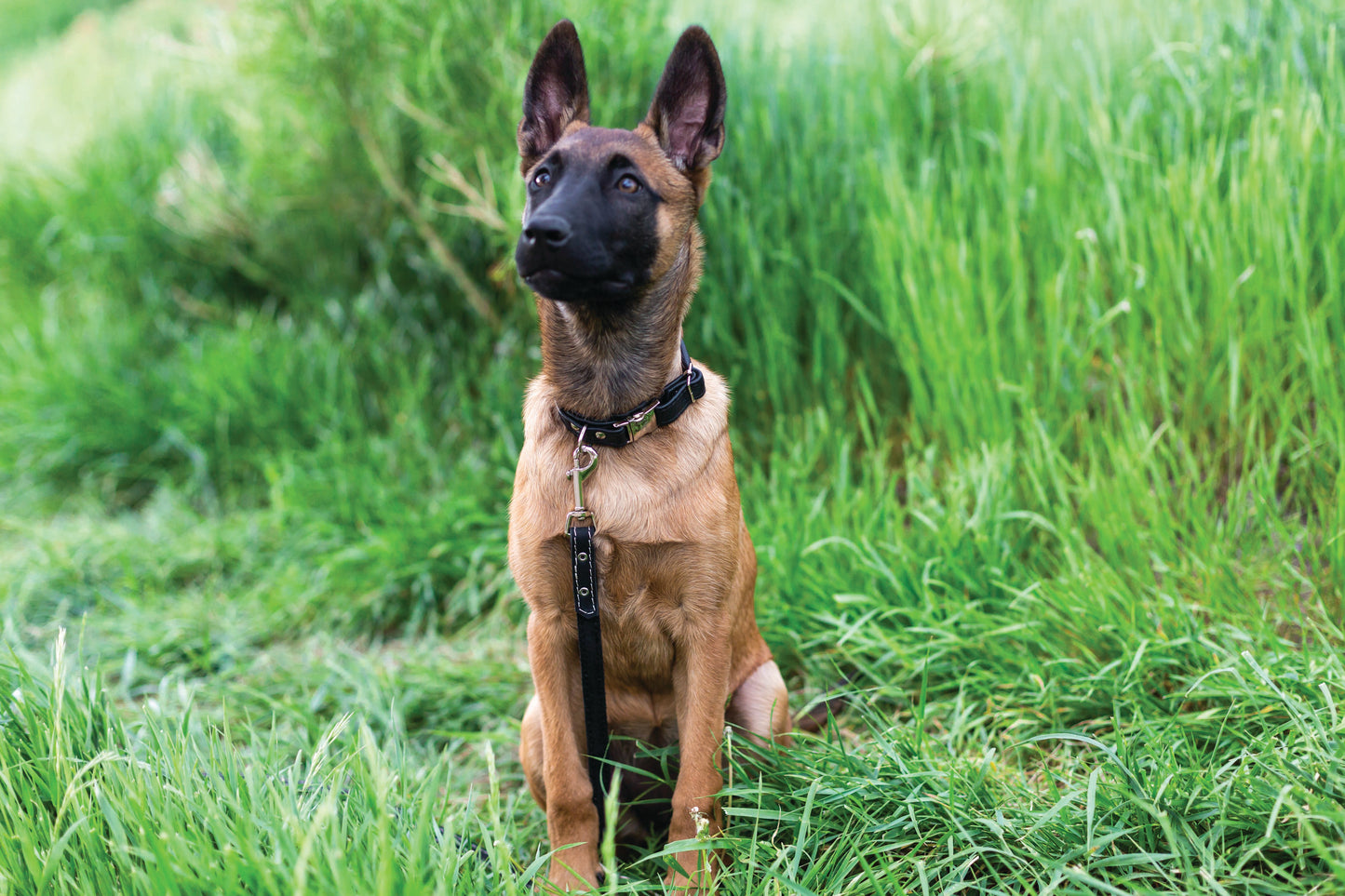
You should be able to slide two fingers comfortably between the collar and your dog's neck. Not loose enough to slip over the head — not tight enough to compress the fur. The collar should sit just above the shoulders, not riding down on the chest or up under the jaw.
Still Not Sure? We're Here.
If you're between sizes, have an unusual breed, or just want a second opinion — email us at info@eurodogcollars.com or give us a call. We've been making collars for nearly 30 years and we'd rather spend two minutes on the phone with you than ship something that doesn't fit.
Our Promise: If your collar doesn't fit, send it back. We'll exchange it. Every Euro-Dog product is backed by our 1-Year Guarantee with no fine print.
Materials
Materials
Real materials. Made in Colorado since 1995.
Most pet-store collars are stamped out of low-grade polyester webbing and pot-metal hardware that fails the moment a real dog tests it. We don't make those. Every Euro-Dog collar, leash, and harness is built in our Colorado workshop using the same four materials we've trusted for nearly thirty years — and the same European-engineered hardware that's never let us down.
Full-Grain American Leather
What it is: The top, outermost layer of the hide — the strongest, most durable grade of leather you can buy. We don't use bonded leather, top-grain leather, split leather, or any of the stamped lookalikes the big brands rely on.
Why we use it: Full-grain leather softens with wear, develops a unique patina, and lasts decades. Our customers regularly send us photos of collars that have been on their dogs for 8, 10, even 15 years.
Best for: Working dogs, hunters, ranch dogs, classic everyday wear, dogs whose owners care about quality.
Mountain Climbing-Grade Nylon Rope
What it is: The same braided kernmantle nylon rope construction used in mountaineering and rock climbing — rated for human weight, then some.
Why we use it: It's lightweight, soft on a dog's coat, doesn't absorb water like flat webbing, and the strength is well above any pull a dog can generate. The braided exterior also resists abrasion from rocks, brush, and rough terrain.
Best for: Hiking, backpacking, water dogs, climbers, runners, and anyone who's tired of leashes that fray.
PVC-Coated Waterproof Nylon
What it is: High-strength nylon webbing sealed in a flexible PVC coating. Water rolls off it. Mud wipes off it.
Why we use it: It doesn't absorb water, doesn't get heavy when wet, doesn't smell after a swim, and wipes clean in seconds. No more leather collars ruined at the lake.
Best for: Swimmers, beach dogs, river dogs, rainy-climate dogs, and any dog whose owner is tired of replacing collars every season.
Heavy Polyester & Nylon Webbing
What it is: Industrial-grade webbing, the kind used in seatbelts and load-bearing tactical gear.
Why we use it: When you need lighter weight than leather but more structure than rope, this is the answer. We pair it with European steel hardware and YKK buckles for a clean, modern collar that takes everything.
The Hardware: European Steel + Japanese YKK Polyacetal Buckles
Materials are only half the story — what holds the collar on your dog is the other half.
European Steel D-Rings & Snap Hooks. European steel is forged to a higher specification than the imported pot-metal hardware most pet brands use. It's stronger, doesn't bend under load, doesn't rust at the seams, and has the tight tolerances that keep snap hooks operating cleanly for years. We've never had a customer report a failed Euro-Dog snap.
Japanese YKK Polyacetal Buckles. YKK is the gold standard in fasteners. Their polyacetal (acetal/POM) side-release buckles are designed in Japan and chosen specifically because they hold under load without cracking in cold, don't degrade in UV, and can take thousands of release cycles without losing their click.
How to Choose
Get leather if: You want a collar that will last a lifetime, develop character, and look as good in 10 years as it does today. Working dogs, hunting dogs, classic style.
Get climbing rope if: Your dog is on the trail, in the field, or in water — and you want light, abrasion-resistant gear that won't fray.
Get waterproof PVC if: Your dog swims, plays in mud, or lives somewhere wet. Easy to clean, never smells.
Get nylon webbing if: You want a lightweight, modern collar with strong hardware at a great price point.
Still not sure? Email us at info@eurodogcollars.com or call us — we've been making these for nearly 30 years and we're happy to talk it through.
Made in Colorado. 1-Year Guarantee. No Fine Print.
Every Euro-Dog product is hand-finished in our Colorado workshop and backed by our 1-Year Guarantee. If something goes wrong with the material or workmanship, we replace or repair it at no charge. No fine print. No catch.
Shipping & Returns
Shipping & Returns
Dimensions
Dimensions
Care Instructions
Care Instructions
Share

-
Free Shipping
Order over $50 for Free Domestic Shipping in the Continental US!
-
Hassle-Free Exchanges
30 Days to Exchange Your Purchase with No Hassle! 1 Year Warranty!